


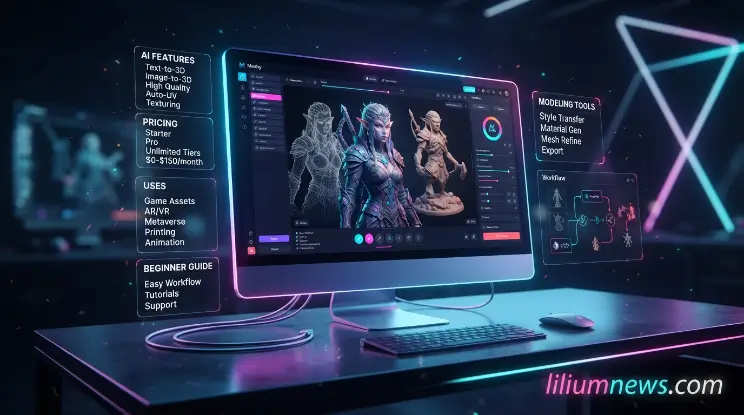
Welcome to Lilium News. Creating high-quality 3D models has traditionally required advanced design skills, expensive software, and hours of manual work. Today, AI-powered tools are changing that process by enabling users to generate detailed 3D assets from simple text prompts or images. Among these tools, Meshy AI has become a popular choice for designers, game developers, digital artists, and businesses looking to streamline 3D content creation. The platform combines advanced machine learning models with an intuitive interface, making professional-quality 3D creation accessible to beginners while providing enough flexibility for experienced creators.
Whether you’re building assets for games, visualizing product concepts, or experimenting with AI-generated designs, Meshy AI offers an intuitive platform that significantly reduces production time. This guide explores how Meshy AI works, its standout features, pricing, practical use cases, and tips to help you get the best results. Unlike traditional 3D modeling software that requires extensive technical knowledge, Meshy AI automates much of the creative workflow. This allows users to spend less time on repetitive modeling tasks and more time refining their ideas.
What Is Meshy AI?
Meshy AI is an AI-powered 3D content creation platform that transforms text descriptions and reference images into detailed 3D models. Instead of manually modeling every object, users simply describe what they want or upload an image, and the platform generates a usable 3D asset within minutes. The platform combines advanced machine learning models with an intuitive interface, making professional-quality 3D creation accessible to beginners while providing enough flexibility for experienced creators. Unlike traditional 3D modeling software that requires extensive technical knowledge, Meshy AI automates much of the creative workflow. This allows users to spend less time on repetitive modeling tasks and more time refining their ideas.
Overview
At its core, Meshy AI focuses on simplifying the creation of 3D assets through artificial intelligence. It supports multiple AI-powered workflows. Unlike traditional 3D modeling software that requires extensive technical knowledge, Meshy AI automates much of the creative workflow. This allows users to spend less time on repetitive modeling tasks and more time refining their ideas.
- Text-to-3D generation
- Image-to-3D conversion
- AI texture generation
- Fast asset exporting
- Integration into existing design workflows
The platform is designed to help users create assets quickly while maintaining a balance between speed and quality.
Who Created Meshy AI?
Meshy AI was founded in 2020 by a team of AI researchers, graphics engineers, and game developers who wanted to simplify the process of creating 3D content. Traditional 3D modeling often requires specialized software, technical skills, and significant time to produce high-quality assets. To address these challenges, the team developed Meshy AI, an AI-powered platform that enables users to generate 3D models and textures from simple text prompts or reference images. This approach makes 3D content creation faster, more accessible, and easier for both beginners and professionals.
Since its launch, Meshy AI has become a trusted tool for indie developers, digital artists, product designers, educators, and businesses across various industries. It is widely used for creating game assets, product prototypes, architectural visualizations, and AR/VR experiences. By automating much of the modeling process, Meshy AI helps users reduce development time, improve productivity, and focus more on creativity instead of complex manual design tasks. Its combination of speed, ease of use, and high-quality output has made it one of the leading AI-powered 3D generation platforms available today.
Who Should Use Meshy AI?
One of the biggest advantages of Meshy AI is its broad appeal across different industries. It is widely used for creating game assets, product prototypes, architectural visualizations, and AR/VR experiences. By automating much of the modeling process, Meshy AI helps users reduce development time, improve productivity, and focus more on creativity instead of complex manual design tasks. Its combination of speed, ease of use, and high-quality output has made it one of the leading AI-powered 3D generation platforms available today.
It is well suited for:
- Game developers creating characters, props, and environments
- 3D artists looking to speed up asset production
- Product designers creating concept visualizations
- Architects producing quick design mockups
- AR and VR developers building immersive experiences
- Marketing teams creating 3D promotional visuals
- Educators teaching digital design concepts
- Hobbyists exploring AI-assisted creativity
Because of its user-friendly interface, beginners can start creating models with minimal learning, while professionals can incorporate generated assets into larger production workflows.
How Meshy AI Works
The strength of Meshy AI lies in its ability to convert simple user input into editable 3D models. It is widely used for creating game assets, product prototypes, architectural visualizations, and AR/VR experiences. By automating much of the modeling process, Meshy AI helps users reduce development time, improve productivity, and focus more on creativity instead of complex manual design tasks. The platform uses advanced generative AI models trained on large datasets of 3D objects, enabling it to interpret prompts and generate realistic geometry and textures.
The typical workflow involves four simple stages:
- Enter a text prompt or upload an image.
- The AI analyzes the input.
- A 3D model is generated.
- The user refines and exports the finished asset.
This streamlined process eliminates many of the time-consuming steps found in traditional 3D modeling software.
Text-to-3D Generation
The Text-to-3D feature allows users to generate models by describing an object in natural language. It is widely used for creating game assets, product prototypes, architectural visualizations, and AR/VR experiences. By automating much of the modeling process, Meshy AI helps users reduce development time, improve productivity, and focus more on creativity instead of complex manual design tasks. Its combination of speed, ease of use, and high-quality output has made it one of the leading AI-powered 3D generation platforms available today.
For example, prompts such as:
- “A medieval wooden treasure chest with metal corners”
- “A futuristic robotic drone with blue glowing lights”
- “A low-poly pine tree for a mobile game”
- Be specific about the object’s shape and style.
- Include material details, such as wood, metal, or glass.
- Mention colors if they are important.
- Specify the intended style, such as realistic, stylized, cartoon, or low-poly.
- Indicate the intended use, such as gaming, animation, or 3D printing.
Well-written prompts generally produce more accurate and visually appealing models.
Image-to-3D Conversion
Another powerful feature is Image-to-3D generation. It is widely used for creating game assets, product prototypes, architectural visualizations, and AR/VR experiences. By automating much of the modeling process, Meshy AI helps users reduce development time, improve productivity, and focus more on creativity instead of complex manual design tasks. Instead of writing a prompt, users upload a reference image. The AI analyzes its structure, proportions, and visual details before creating a corresponding 3D model.
This workflow is particularly useful for:
- Product visualization
- Character concepts
- Sculptures
- Furniture models
- Consumer products
- Prototype development
It helps designers quickly convert existing concepts into editable 3D assets without rebuilding them from scratch.
AI Texture Generation
Creating textures manually often requires additional software and significant artistic effort. Meshy AI simplifies this step with AI-powered texture generation. Users can automatically generate high-quality textures that match the geometry of their models. Depending on the project, textures can range from realistic materials such as wood, stone, and metal to stylized finishes suitable for games and animations.
This feature helps maintain visual consistency while reducing the time needed for manual UV mapping and texture painting. It is widely used for creating game assets, product prototypes, architectural visualizations, and AR/VR experiences. By automating much of the modeling process, Meshy AI helps users reduce development time, improve productivity, and focus more on creativity instead of complex manual design tasks. Its combination of speed, ease of use, and high-quality output has made it one of the leading AI-powered 3D generation platforms available today.
Export Options
Once a model is complete, Meshy AI allows users to export it in formats compatible with many popular 3D applications and game engines. It is widely used for creating game assets, product prototypes, architectural visualizations, and AR/VR experiences. By automating much of the modeling process, Meshy AI helps users reduce development time, improve productivity, and focus more on creativity instead of complex manual design tasks. Its combination of speed, ease of use, and high-quality output has made it one of the leading AI-powered 3D generation platforms available today.
Common export options include formats that work with:
- Blender
- Unity
- Unreal Engine
- Autodesk Maya
- Cinema 4D
- 3D printing workflows
This flexibility makes it easier to integrate AI-generated assets into existing production pipelines without extensive conversion work.
Read also: AI Expand Image: Complete Guide To Expanding Photos with AI (2026)
Key Features, How to Use Meshy AI, and Pricing
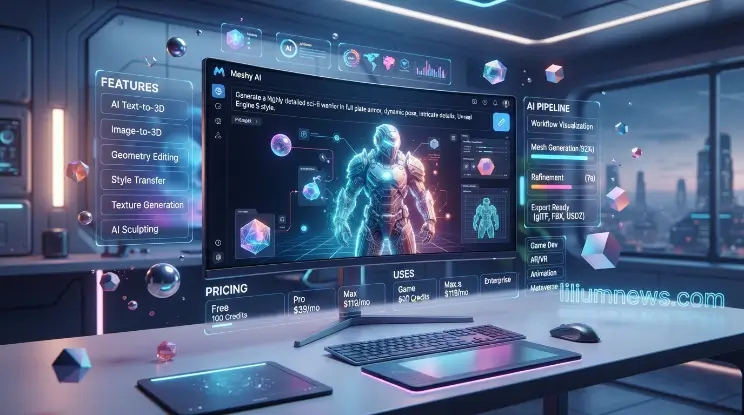
Meshy AI offers a range of AI-powered features that make 3D content creation faster and easier for beginners and professionals. Its main capabilities include text-to-3D generation, image-to-3D conversion, and AI texturing. Users can create 3D models by entering simple descriptions or uploading images, while the platform automatically generates the shape, structure, and textures. These features help game developers, designers, and digital artists create assets without spending hours on traditional manual modeling. The platform also supports exporting models for use in popular 3D software and workflows, making it useful for game development, product visualization, animation, and 3D printing projects.
AI 3D Model Generator
The AI 3D model generator is the core feature of Meshy AI. It allows users to create detailed 3D objects by entering simple text descriptions. The AI interprets the prompt, understands the object structure, and generates a complete 3D model. The platform also supports exporting models for use in popular 3D software and workflows, making it useful for game development, product visualization, animation, and 3D printing projects.
For example, a user can enter a prompt like:
“Create a realistic medieval warrior helmet with metallic details.”
The platform can generate a 3D model based on the description, reducing the need for manual modeling.
This feature is useful for:
- Game assets
- Character concepts
- Environment objects
- Product prototypes
- Creative experiments
The quality of results depends heavily on the prompt details. More specific descriptions usually produce more accurate models.
AI Texturing
Creating realistic textures is often one of the most time-consuming parts of 3D design. Meshy AI simplifies this process by automatically generating textures based on the model’s shape and user instructions. Users can apply different styles, materials, and visual effects to their models without manually creating texture maps.
AI texturing helps create:
- Realistic surfaces
- Stylized game assets
- Product materials
- Environmental objects
- Character designs
This feature allows creators to quickly transform basic models into visually complete assets.
Animation and Rigging Support
For creators working with characters and interactive projects, Meshy AI provides features that support animation workflows. Generated models can be prepared for use in animation projects, games, and digital experiences. While professional animation may still require additional software, AI-assisted workflows help reduce the initial production time.
This makes Meshy AI useful for:
- Indie game development
- Character prototyping
- Virtual environments
- Digital storytelling projects
API Integration
For businesses and developers, Meshy AI provides API access that allows AI-powered 3D generation features to be integrated into custom applications and workflows. The platform also supports exporting models for use in popular 3D software and workflows, making it useful for game development, product visualization, animation, and 3D printing projects.
Developers can use the API to automate tasks such as:
- Creating 3D assets automatically
- Generating models inside applications
- Building custom design tools
- Adding AI modeling features to existing platforms
This is especially valuable for companies that need large-scale 3D content production.
Multiple Export Formats
A major advantage of Meshy AI is its compatibility with popular 3D software and game development platforms. The platform also supports exporting models for use in popular 3D software and workflows, making it useful for game development, product visualization, animation, and 3D printing projects. This is especially valuable for companies that need large-scale 3D content production.
Generated models can be exported for use in:
- Blender
- Unity
- Unreal Engine
- Autodesk Maya
- Cinema 4D
- 3D printing applications
This flexibility allows creators to include AI-generated assets directly into existing workflows without rebuilding models from scratch.
How to Use Meshy AI (Step-by-Step)
Using Meshy AI does not require advanced 3D modeling experience. The platform is designed with a simple workflow that allows beginners to create assets quickly. The platform also supports exporting models for use in popular 3D software and workflows, making it useful for game development, product visualization, animation, and 3D printing projects. With API integration and different pricing plans, Meshy AI can support both individual creators and businesses that need a faster way to produce high-quality 3D assets. Its simple workflow allows users to generate, refine, and export models with minimal technical knowledge.
Step 1: Create an Account
The first step is creating a Meshy AI account. After signing up, users can access the dashboard and explore available AI generation tools. With API integration and different pricing plans, Meshy AI can support both individual creators and businesses that need a faster way to produce high-quality 3D assets. Its simple workflow allows users to generate, refine, and export models with minimal technical knowledge.
The dashboard provides access to:
- Text-to-3D generation
- Image-to-3D conversion
- Texture creation
- Model management
- Export options
Step 2: Choose a Generation Mode
After entering the platform, users need to select the type of content they want to create. The main options include: Users describe an object using written instructions, and the AI generates a 3D model. Users upload an image, and the AI converts it into a 3D model.
Example:
“A futuristic sports car with aerodynamic design and metallic paint.”
Users upload an image, and the AI converts it into a 3D model.
This option works well for:
- Product concepts
- Character references
- Objects from images
- Design prototypes
Step 3: Write an Effective Prompt
The quality of the generated model depends greatly on the prompt. Users upload an image, and the AI converts it into a 3D model. Its main capabilities include text-to-3D generation, image-to-3D conversion, and AI texturing. Users can create 3D models by entering simple descriptions or uploading images, while the platform automatically generates the shape, structure, and textures. These features help game developers, designers, and digital artists create assets without spending hours on traditional manual modeling.
A good prompt should include:
- Object name
- Style
- Materials
- Colors
- Level of detail
- Intended purpose
Weak prompt:
“Create a sword.”
Better prompt:
“Create a fantasy medieval sword with a detailed golden handle, engraved blade, and realistic metal texture.”
Detailed prompts help Meshy AI better understand the user’s expectations.
Step 4: Generate and Edit the Model
After submitting the prompt, Meshy AI processes the request and creates a 3D model. Users can review the generated result and make adjustments if needed. Depending on the project requirements, creators may refine the model. Its main capabilities include text-to-3D generation, image-to-3D conversion, and AI texturing. Users can create 3D models by entering simple descriptions or uploading images, while the platform automatically generates the shape, structure, and textures.
- Model appearance
- Texture style
- Level of detail
- Material properties
Multiple generations can be created until the desired result is achieved.
Step 5: Export Your Asset
Once satisfied with the model, users can export it for use in other applications. Its main capabilities include text-to-3D generation, image-to-3D conversion, and AI texturing. Users can create 3D models by entering simple descriptions or uploading images, while the platform automatically generates the shape, structure, and textures. These features help game developers, designers, and digital artists create assets without spending hours on traditional manual modeling.
Exported assets can be used for:
- Video games
- Animations
- Virtual reality projects
- Product presentations
- 3D printing
This makes Meshy AI a practical solution for both creative projects and professional workflows.
Meshy AI Pricing
Meshy AI offers different pricing options designed for beginners, individual creators, and professional users. The available plans generally differ based on generation credits, export features, and usage limits. Its main capabilities include text-to-3D generation, image-to-3D conversion, and AI texturing. Users can create 3D models by entering simple descriptions or uploading images, while the platform automatically generates the shape, structure, and textures. These features help game developers, designers, and digital artists create assets without spending hours on traditional manual modeling.
Free Plan
The free plan allows users to test the platform and explore AI-powered 3D generation features. Its main capabilities include text-to-3D generation, image-to-3D conversion, and AI texturing. Users can create 3D models by entering simple descriptions or uploading images, while the platform automatically generates the shape, structure, and textures. These features help game developers, designers, and digital artists create assets without spending hours on traditional manual modeling.
It is suitable for:
- Beginners learning the platform
- Small experiments
- Testing AI-generated models
However, free users usually have limitations on credits, generation speed, and advanced features.
Paid Plans
Paid plans provide additional resources for users who need regular 3D asset creation. Their main capabilities include text-to-3D generation, image-to-3D conversion, and AI texturing. Users can create 3D models by entering simple descriptions or uploading images, while the platform automatically generates the shape, structure, and textures. These features help game developers, designers, and digital artists create assets without spending hours on traditional manual modeling.
Premium features may include:
- More monthly credits
- Faster generation
- Higher-quality exports
- Commercial usage options
- Additional workflow features
These plans are more suitable for designers, developers, and businesses creating multiple assets.
Credits Explained
Meshy AI uses a credit-based system where generations consume credits depending on the complexity and type of request. Its main capabilities include text-to-3D generation, image-to-3D conversion, and AI texturing. Users can create 3D models by entering simple descriptions or uploading images, while the platform automatically generates the shape, structure, and textures. These features help game developers, designers, and digital artists create assets without spending hours on traditional manual modeling.
Users should consider their workflow before choosing a plan:
- Occasional users may prefer free access
- Independent creators may benefit from standard plans
- Studios and businesses may need higher-tier plans
Frequently Asked Questions
What is Meshy AI used for?
Meshy AI is used to generate 3D models and textures from text prompts or images. It is commonly used for game development, product design, architecture, education, animation, and AR/VR projects.
Is Meshy AI free?
Yes. Meshy AI offers a free plan that allows users to explore its features with limited credits. Paid plans provide additional credits, faster generation, and commercial usage options.
Can Meshy AI create game-ready models?
Yes, Meshy AI can generate assets suitable for game development. However, developers may need to optimize or refine the models in software such as Blender or Unity before using them in production.
Which file formats does Meshy AI support?
Meshy AI supports exporting models in commonly used 3D formats that are compatible with software like Blender, Unity, Unreal Engine, and other professional design tools.
Is Meshy AI suitable for beginners?
Absolutely. Its intuitive interface, AI-powered workflows, and simple prompt-based system make it accessible to users with little or no previous experience in 3D modeling.
Conclusion
Meshy AI has transformed the way creators produce 3D content by making the process faster, more accessible, and less dependent on advanced technical skills. Whether you are a beginner exploring AI-powered design or a professional looking to speed up asset creation, the platform offers an efficient solution for generating high-quality 3D models from text prompts or images.
With features such as Text-to-3D generation, Image-to-3D conversion, AI texturing, flexible export options, and API integration, Meshy AI supports a wide variety of creative and professional workflows. While some complex projects may still require manual refinement, its ability to automate much of the modeling process makes it a valuable tool for game development, product visualization, education, architecture, and immersive technologies. If you want to create 3D assets more efficiently, Meshy AI is well worth exploring.
