


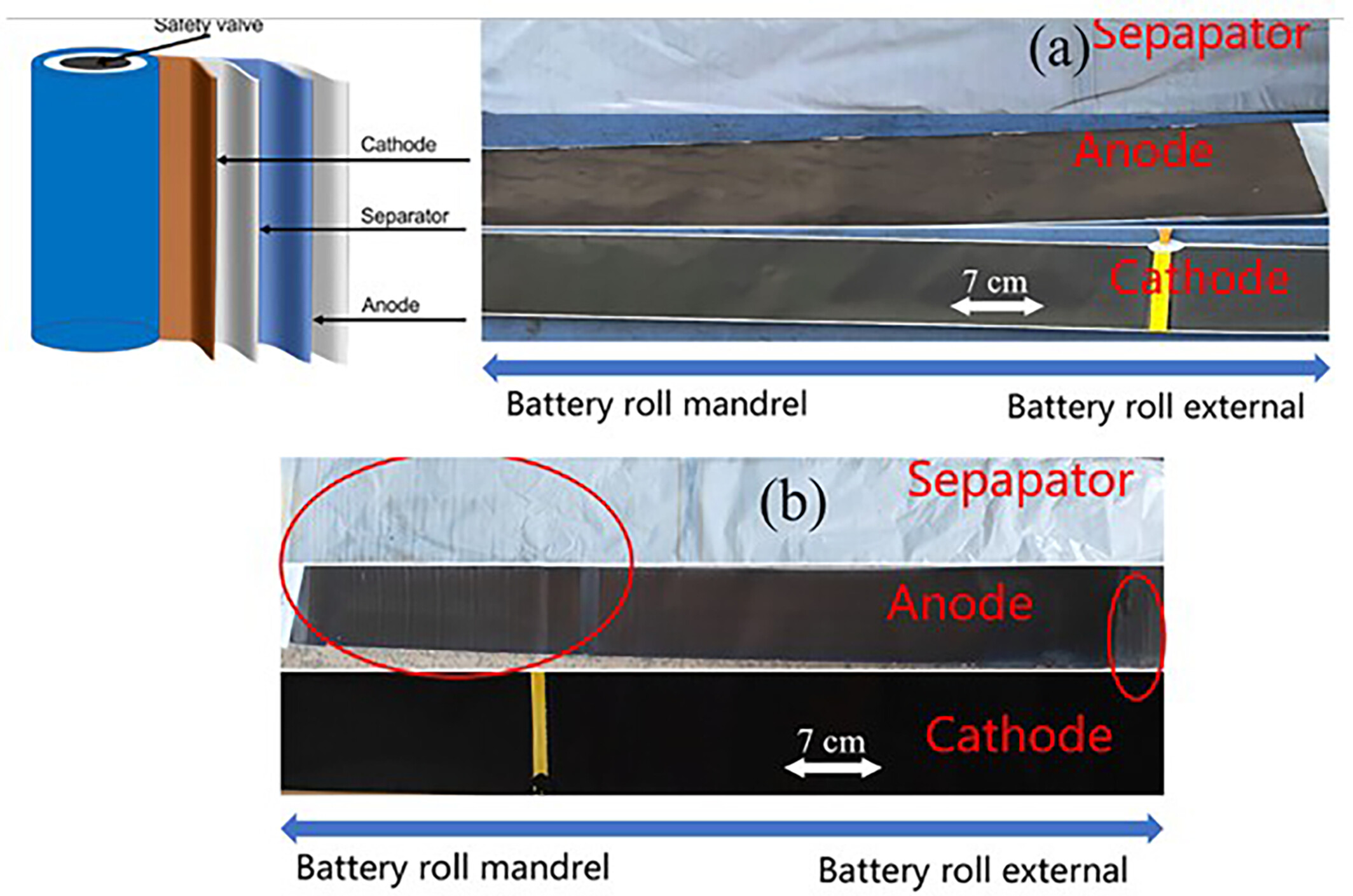
Every electric vehicle battery lives a shaken life. Road roughness, motor torque, and chassis resonance send continuous vibration into the pack. Yet most battery models treat mechanical stress and electrochemistry as separate worlds. A recent multiphysics study on coupled electro-chemo-mechanical degradation in lithium-ion batteries under forced vibration bridges that gap, and the first step is understanding how vibration actually reaches the particles inside the cell.
From the road to the electrode particle
The model starts with simple harmonic base excitation, the same sinusoidal input used in standard vibration tests (SAE, IEC):
y(t) = A sin(ωt), with ω = 2πf
Here A is the displacement amplitude and f the frequency. What matters for the battery, however, is acceleration, because internal forces scale with acceleration rather than displacement. Differentiating twice gives:
ÿ(t) = −Aω² sin(ωt)
Notice the ω² term. Doubling the frequency quadruples the acceleration for the same amplitude.
D’Alembert’s principle: every particle feels a force
When the cell accelerates, each active-material particle experiences an inertial force proportional to its mass (D’Alembert’s principle):
F_inertial(t) = −m·A·ω²·sin(ωt)
Dividing by the particle’s surface area gives the equivalent stress from vibration:
P_v = m·A·ω²·sin(2πft) / A_surface
Electrode particles sit inside a binder matrix. As the electrode shakes, the binder holds each particle back, creating relative displacement between particle and matrix. This adds tangential stress on the particle surface on top of the usual diffusion-induced (hydrostatic) stress.
The vibration-to-stress transfer factor
The authors condense all this into one compact relationship, which they define in the modelling section of the paper:
σ_vib(t) = S_v · a(t), where S_v = m / A_surface
S_v is the vibration-to-stress transfer factor. It tells us how much mechanical stress a given acceleration produces at the particle level, and it captures the particle-binder interaction in a single parameter.
Stress superposition
Lithium insertion already causes chemical swelling, which generates diffusion-induced stress during normal cycling. Because the electrode is assumed to remain in the linear elastic regime, the vibration stress and the chemical stress can simply be added together (linear superposition). The result is an oscillating mechanical component riding on top of an evolving chemical stress field.
The vibration stress also shifts the electrochemistry directly. The effective overpotential becomes:
η = η₀ − (Ω/F)·σ_vib(t)
where Ω is the partial molar volume of lithium and F is Faraday’s constant. Tensile stress enhances the reaction rate, while compressive stress suppresses it.
What this means in practice
- Amplitude and frequency act differently. Stress grows linearly with amplitude but with the square of frequency. Even so, the study found amplitude to be the more dominant driver of capacity fade and heating.
- Static models underestimate degradation. Without this stress pathway, a model cannot see the cracking, SEI damage, and resistance growth that follow.
- Design implications. Binder strength, particle-binder adhesion, and cell mounting all influence how much stress reaches the particles, which points toward vibration-tolerant electrode design.
A note on assumptions
This framework assumes uniform stress at the particle scale, spherical and isotropic particles, and a spatially uniform vibration field. Some damage parameters are phenomenological because direct vibration-specific measurements are limited. The model is best read as a mechanistic framework for understanding trends, not a final lifetime predictor.
Takeaway
Vibration is not just a structural problem. Through the transfer factor S_v, it becomes a stress at the particle level, and that stress feeds crack growth, SEI instability, and heat generation. Understanding this first link is the foundation for the whole degradation chain.
