


Welcome to Lilium News. Artificial intelligence has become one of the most transformative technologies of the modern era, powering everything from virtual assistants and recommendation systems to self-driving cars and advanced chatbots. As AI continues to reshape industries and everyday life, many people naturally ask, “ Who invented AI?” The answer is more fascinating than it may seem because AI was not created by a single inventor. Instead, it evolved through the groundbreaking work of several visionary scientists and researchers over many decades.
Understanding who invented ai requires looking back at the history of computing, mathematics, and cognitive science. While John McCarthy is widely recognized as the “Father of Artificial Intelligence” for introducing the term Artificial Intelligence in 1956, pioneers like Alan Turing, Marvin Minsky, Claude Shannon, Allen Newell, Herbert Simon, and Geoffrey Hinton all made remarkable contributions that shaped the AI systems we use today. In this guide, we’ll explore the complete history of AI, the people behind its development, and the milestones that transformed an ambitious idea into a revolutionary technology.
What Is Artificial Intelligence?
Artificial Intelligence (AI) is a branch of computer science that focuses on creating machines capable of performing tasks that typically require human intelligence. These tasks include learning from data, recognizing speech and images, solving problems, making decisions, translating languages, and understanding natural language. Unlike traditional computer programs that follow fixed instructions, modern AI systems can improve their performance by analyzing data and identifying patterns. This ability to learn and adapt has made AI one of the fastest-growing technologies in the world.
Definition of AI
Artificial Intelligence is the simulation of human intelligence by machines. These systems are designed to perform tasks such as: Although AI appears highly advanced today, its foundations were established decades ago by researchers who believed that machines could one day simulate aspects of human intelligence.
- Learning from experience
- Reasoning and problem-solving
- Understanding language
- Recognizing images and speech
- Making predictions
- Adapting to new information
AI encompasses several subfields, including:
| AI Field | Purpose |
| Machine Learning | Learns patterns from data |
| Deep Learning | Uses neural networks for complex tasks |
| Natural Language Processing (NLP) | Understands and generates human language |
| Computer Vision | Recognizes and interprets images and videos |
| Robotics | Enables intelligent machines to interact with the physical world |
Each of these technologies builds on decades of research conducted by AI pioneers.
Why AI Is Often Misunderstood
Many people believe AI refers only to advanced robots or futuristic machines. In reality, AI is much broader and includes software that can analyze information, automate decisions, and improve over time. Although AI appears highly advanced today, its foundations were established decades ago by researchers who believed that machines could one day simulate aspects of human intelligence.
Another common misconception is that one person invented AI. Since people often search for “ who invented ai,” they expect a single inventor similar to Thomas Edison or Alexander Graham Bell. However, AI is the result of decades of collaboration among mathematicians, computer scientists, engineers, and researchers. Understanding this collaborative history helps explain why several individuals are recognized as pioneers of artificial intelligence rather than a single inventor.
Who Invented AI?
The short answer is that no single person invented AI. Artificial Intelligence developed gradually through the combined efforts of many brilliant researchers. Each contributed unique ideas that laid the foundation for modern AI systems. Although AI appears highly advanced today, its foundations were established decades ago by researchers who believed that machines could one day simulate aspects of human intelligence.
Among these contributors:
- Alan Turing introduced the concept that machines could think.
- John McCarthy coined the term Artificial Intelligence.
- Marvin Minsky advanced AI research through cognitive science.
- Claude Shannon established the mathematical foundations of information theory.
- Allen Newell and Herbert Simon developed some of the earliest AI programs.
- Geoffrey Hinton helped popularize deep learning, which powers many modern AI applications.
This collaborative effort means that answering who invented AI requires understanding the role each pioneer played in shaping the field.
The Short Answer
If someone asks who invented AI, the most accurate answer is: Artificial Intelligence was not invented by one person. John McCarthy is widely recognized as the Father of AI because he coined the term Artificial Intelligence and organized the Dartmouth Conference in 1956, while Alan Turing laid the theoretical foundation years earlier.
This distinction is important because Turing explored the possibility of intelligent machines before the field even had a name, whereas McCarthy formally established AI as a scientific discipline. Although AI appears highly advanced today, its foundations were established decades ago by researchers who believed that machines could one day simulate aspects of human intelligence.
Why AI Has No Single Inventor
Unlike inventions such as the telephone or the light bulb, AI is a scientific field rather than a single product. It combines concepts from several disciplines, including: Each breakthrough built upon previous discoveries. Researchers around the world contributed algorithms, theories, and technologies that collectively advanced artificial intelligence. Because of this collaborative evolution, historians and researchers generally avoid naming one sole inventor of AI.
- Mathematics
- Computer science
- Psychology
- Neuroscience
- Linguistics
- Statistics
- Engineering
Each breakthrough built upon previous discoveries. Researchers around the world contributed algorithms, theories, and technologies that collectively advanced artificial intelligence.
Because of this collaborative evolution, historians and researchers generally avoid naming one sole inventor of AI.
The Official Birth of AI
Although the ideas behind intelligent machines date back much earlier, the year 1956 is widely regarded as the official beginning of Artificial Intelligence as an academic discipline. During the famous Dartmouth Summer Research Project on Artificial Intelligence, a group of leading researchers gathered to explore whether machines could simulate human intelligence.
This conference was groundbreaking because it:
- Introduced the term “Artificial Intelligence”
- Established AI as a formal research field
- Encouraged collaboration among scientists
- Inspired decades of AI research
The event marked the transition from theoretical ideas to organized scientific exploration, making it a defining moment in AI history.
Read Also: ai ka matlab kya hota hai
John McCarthy: The Father of AI

When discussing who invented ai, one name consistently stands out: John McCarthy. Although he did not single-handedly invent artificial intelligence, he played a defining role in shaping the field and is widely recognized as the Father of Artificial Intelligence.McCarthy believed that machines could eventually perform tasks requiring human intelligence. His vision extended far beyond the computing capabilities of his time, influencing generations of researchers and innovators.
Who Was John McCarthy?
John McCarthy was an American computer scientist and cognitive scientist born in 1927. He became one of the leading figures in computer science by advocating for research into intelligent machines. Throughout his career, he worked at prestigious institutions such as:
- Dartmouth College
- Massachusetts Institute of Technology (MIT)
- Stanford University
His work helped transform AI from a theoretical concept into a respected academic discipline.
Coining the Term “Artificial Intelligence”
One of McCarthy’s most significant achievements was introducing the term Artificial Intelligence in 1955 while preparing the proposal for the Dartmouth Summer Research Project. Before then, researchers explored machine intelligence under different names, but there was no unified field. McCarthy’s terminology gave scientists a common identity and direction, allowing AI research to grow rapidly in the years that followed.
His decision to use the phrase Artificial Intelligence continues to shape the field and remains one of the most influential moments in the history of computer science. Each breakthrough built upon previous discoveries. Researchers around the world contributed algorithms, theories, and technologies that collectively advanced artificial intelligence.
Major Contributions of John McCarthy
Beyond naming the field, John McCarthy made several lasting contributions: Each breakthrough built upon previous discoveries. Researchers around the world contributed algorithms, theories, and technologies that collectively advanced artificial intelligence. Because of this collaborative evolution, historians and researchers generally avoid naming one sole inventor of AI.
- Organized the Dartmouth Conference in 1956
- Developed the Lisp programming language, which became a cornerstone of early AI research
- Promoted time-sharing systems in computing
- Advanced research in reasoning, logic, and machine intelligence
- Inspired future generations of AI scientists
Because of these achievements, McCarthy’s legacy extends far beyond simply naming AI; he helped create the intellectual framework that allowed artificial intelligence to flourish.
Alan Turing’s Role in AI
When discussing who invented ai, Alan Turing is one of the first names that comes up. Although he did not coin the term Artificial Intelligence, his groundbreaking ideas laid the theoretical foundation for modern AI.His work inspired generations of researchers and remains one of the cornerstones of artificial intelligence.
Alan Turing was a British mathematician, computer scientist, and cryptanalyst. During World War II, he played a crucial role in breaking the German Enigma code, helping shorten the war. Beyond his wartime achievements, Turing explored a revolutionary question: Can machines think? His work inspired generations of researchers and remains one of the cornerstones of artificial intelligence.
The Turing Test
In 1950, Alan Turing published his famous paper Computing Machinery and Intelligence, introducing what is now known as the Turing Test. The test evaluates whether a machine can imitate human conversation well enough that a person cannot reliably distinguish it from another human.
Although modern AI has advanced far beyond the original Turing Test, the concept remains an important milestone in AI history. Turing argued that instead of asking whether machines can truly “think,” we should ask whether they can perform tasks that appear intelligent. His work inspired generations of researchers and remains one of the cornerstones of artificial intelligence.
Can Machines Think?
Turing argued that instead of asking whether machines can truly “think,” we should ask whether they can perform tasks that appear intelligent. This idea shifted AI research toward practical problem-solving and inspired decades of innovation in areas such as computer vision. Today, many AI applications from virtual assistants to chatbots reflect the vision Turing described more than 70 years ago.
- Natural Language Processing (NLP)
- Machine Learning
- Robotics
- Computer Vision
Today, many AI applications from virtual assistants to chatbots reflect the vision Turing described more than 70 years ago.
Why Alan Turing Matters
Alan Turing’s contributions include: Computer Vision. Held in 1956 at Dartmouth College in the United States, this workshop brought together leading scientists to explore whether machines could simulate human intelligence. Today, many AI applications from virtual assistants to chatbots reflect the vision Turing described more than 70 years ago.
- Introducing the concept of machine intelligence
- Developing the Turing Test
- Establishing theoretical computer science
- Inspiring future AI researchers
While John McCarthy officially named the field, Turing provided many of the ideas that made artificial intelligence possible.
The Dartmouth Conference (1956)
The Dartmouth Summer Research Project on Artificial Intelligence is widely regarded as the birthplace of modern AI. Held in 1956 at Dartmouth College in the United States, this workshop brought together leading scientists to explore whether machines could simulate human intelligence. When discussing who invented ai, Alan Turing is one of the first names that comes up. Although he did not coin the term Artificial Intelligence, his groundbreaking ideas laid the theoretical foundation for modern AI.His work inspired generations of researchers and remains one of the cornerstones of artificial intelligence.
What Happened?
John McCarthy organized the conference to bring researchers together to discuss intelligent machines. In this blog, you’ll learn how participants believed that significant progress could be achieved if scientists collaborated on machine reasoning, learning, and problem-solving.
Although AI advanced more slowly than expected, the conference established a clear direction for future research. While John McCarthy is widely credited with coining the term “Artificial Intelligence,” his groundbreaking ideas also laid the theoretical foundation for modern AI. His work inspired generations of researchers and remains one of the cornerstones of artificial intelligence.
Why It Changed Computing Forever
The conference transformed AI from a theoretical concept into an organized scientific discipline by: Although he did not coin the term Artificial Intelligence, his groundbreaking ideas laid the theoretical foundation for modern AI.His work inspired generations of researchers and remains one of the cornerstones of artificial intelligence.
- Creating a shared research vision
- Encouraging collaboration among experts
- Inspiring universities to establish AI research programs
- Launching decades of innovation
Without this event, artificial intelligence might have developed much more slowly.
Scientists Who Participated
Some of the influential researchers involved included: John McCarthy organized the conference to bring researchers together to discuss intelligent machines. Participants believed that significant progress could be achieved if scientists collaborated on machine reasoning, learning, and problem-solving.
- John McCarthy
- Marvin Minsky
- Claude Shannon
- Nathaniel Rochester
- Allen Newell
- Herbert Simon
Their combined efforts shaped the future of AI research.
Other AI Pioneers
Although John McCarthy and Alan Turing receive much of the attention, many other scientists made essential contributions to AI. John McCarthy organized the conference to bring researchers together to discuss intelligent machines. Participants believed that significant progress could be achieved if scientists collaborated on machine reasoning, learning, and problem-solving. Marvin Minsky co-founded the MIT Artificial Intelligence Laboratory and became one of the most influential AI researchers of the twentieth century. His work focused on machine perception, reasoning, and cognitive science.
Marvin Minsky
Marvin Minsky was an American computer scientist and one of the leading pioneers of artificial intelligence. He co-founded the MIT Artificial Intelligence Laboratory, which became one of the world’s top AI research centers. His work focused on machine perception, reasoning, and cognitive science, helping researchers better understand how machines could perform intelligent tasks.
Minsky believed that computers could eventually think and solve problems in ways similar to humans. Through his research, books, and innovative ideas, he played a key role in the early development of AI. His contributions continue to influence modern artificial intelligence, machine learning, and robotics.
Claude Shannon
Claude Shannon was an American mathematician and engineer, widely known as the Father of Information Theory. He developed mathematical principles that revolutionized digital communication and became the foundation of modern computing. His work made it possible to transmit, store, and process information efficiently.
Although Shannon did not invent artificial intelligence, his groundbreaking research provided the mathematical foundation that AI systems rely on today. His contributions to data processing, logic, and communication continue to play a vital role in the development of modern AI technologies.
Allen Newell
Allen Newell was an American computer scientist and one of the pioneers of artificial intelligence. Along with Herbert Simon, he developed some of the earliest AI programs, including the Logic Theorist, which could solve mathematical and logical problems. His work proved that computers could perform tasks that required human-like reasoning.
Newell’s research played a key role in the early development of AI by showing that machines could imitate aspects of human thinking and decision-making. His contributions laid the foundation for modern artificial intelligence and continue to influence AI research today.
Herbert Simon
Herbert Simon was an American economist, political scientist, and one of the early pioneers of artificial intelligence. Together with Allen Newell, he developed the Logic Theorist, one of the first successful AI programs capable of solving logical and mathematical problems. This breakthrough demonstrated that computers could imitate certain aspects of human reasoning.
Simon believed that intelligent machines would eventually perform many tasks traditionally carried out by humans. His research and predictions helped shape the future of AI and inspired decades of innovation in machine learning, problem-solving, and intelligent systems.
Geoffrey Hinton
Often called the Godfather of Deep Learning, Geoffrey Hinton revolutionized modern AI through his research on artificial neural networks. Simon believed that intelligent machines would eventually perform many tasks traditionally carried out by humans. His research and predictions helped shape the future of AI and inspired decades of innovation in machine learning, problem-solving, and intelligent systems.
His work helped make possible today’s:
- Image recognition
- Speech recognition
- Large Language Models
- Generative AI
- Autonomous systems
Many breakthroughs behind ChatGPT and other AI tools rely on deep learning techniques that Hinton helped pioneer.
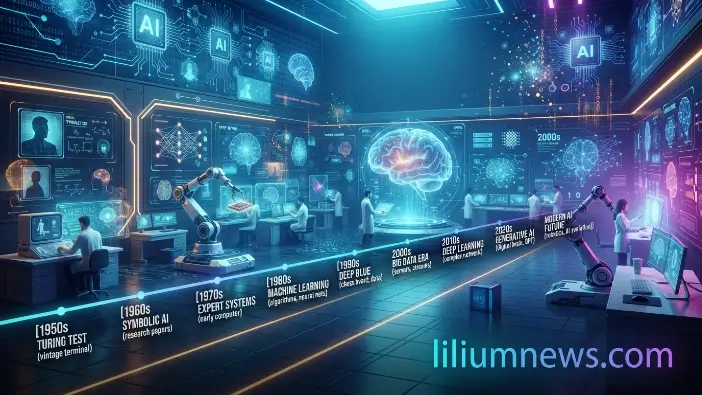
Evolution of AI Through the Years
Artificial intelligence has evolved significantly over the past several decades, transforming from a theoretical concept into a powerful technology used worldwide. Thanks to continuous advancements in computing power, data availability, and research, AI now powers applications such as virtual assistants, self-driving cars, healthcare systems, and generative AI tools like ChatGPT. Many breakthroughs behind ChatGPT and other AI tools rely on deep learning techniques that Hinton helped pioneer.
Early AI (1950s–1960s)
During the early years of AI in the 1950s and 1960s, researchers focused on symbolic reasoning, rule-based systems, and simple problem-solving programs. They believed that by teaching computers to follow logical rules, machines could perform tasks similar to human thinking.
The excitement surrounding these early developments led to high expectations. Many scientists predicted that human-level artificial intelligence would be achieved within a few decades. However, limited computing power and a lack of sufficient data made progress much slower than anticipated.
The AI Winter
During the 1970s and again in the late 1980s, the progress of artificial intelligence slowed considerably. Researchers faced challenges such as limited computing power, a lack of high-quality data, and unrealistic expectations about what AI could achieve. As a result, many AI projects failed to deliver the expected results.
These setbacks caused governments and private organizations to reduce funding for AI research. This period became known as the AI Winter, a time when interest and investment in artificial intelligence declined significantly before the field experienced a major revival years later.
The Machine Learning Revolution
During the 1990s and early 2000s, artificial intelligence experienced a major transformation with the rise of Machine Learning. Instead of relying only on predefined rules, computers began learning from large amounts of data, enabling them to identify patterns, make predictions, and improve their performance over time.
This shift greatly enhanced the accuracy and efficiency of AI systems across many industries. Machine learning became the foundation for applications such as recommendation systems, fraud detection, speech recognition, image classification, and many other intelligent technologies used today.
The Deep Learning Era
The development of powerful graphics processing units (GPUs), access to larger datasets, and improvements in artificial neural networks accelerated the growth of deep learning. These advancements enabled AI models to process vast amounts of information more efficiently and learn from complex data patterns.
As a result, AI systems became much more capable of recognizing images, understanding speech, translating languages, and generating realistic text, audio, and images. These breakthroughs have powered many of today’s advanced AI applications, including virtual assistants, autonomous vehicles, and generative AI tools like ChatGPT.
The Rise of Generative AI
The introduction of transformer-based models and large language models ushered in a new era of AI. These breakthroughs have powered many of today’s advanced AI applications, including virtual assistants, autonomous vehicles, and generative AI tools like ChatGPT.Generative AI has made artificial intelligence accessible to millions of people worldwide.
Modern systems can now:
- Write articles
- Generate images
- Create software code
- Translate languages
- Summarize documents
- Answer complex questions
Generative AI has made artificial intelligence accessible to millions of people worldwide.
Timeline of Important AI Milestones
As a result, AI systems became much more capable of recognizing images, understanding speech, translating languages, and generating realistic text, audio, and images. These breakthroughs have powered many of today’s advanced AI applications, including virtual assistants, autonomous vehicles, and generative AI tools like ChatGPT.
| Year | Milestone |
| 1936 | Alan Turing introduces the concept of the Turing Machine |
| 1950 | Turing Test proposed |
| 1956 | Dartmouth Conference officially launches AI research |
| 1958 | Lisp programming language created |
| 1966 | Early conversational AI programs emerge |
| 1980s | Expert systems become popular |
| 1997 | IBM Deep Blue defeats Garry Kasparov |
| 2012 | Deep learning achieves breakthroughs |
| 2017 | Transformer architecture introduced |
| 2022 | Generative AI gains widespread public attention |
| Present | AI powers healthcare, finance, education, and business |
Common Myths About AI
As artificial intelligence continues to evolve, many myths and misconceptions have emerged about its origins and capabilities. Some people believe AI was invented by a single person, while others think it can think and feel exactly like humans. These misunderstandings often create unrealistic expectations about what AI can and cannot do. Understanding the facts behind these common myths is important because it helps us appreciate how AI has developed over decades through the contributions of many researchers.
Myth 1: One Person Invented AI
Many people believe that artificial intelligence was invented by a single person, but this is a common myth. The answer to who invented ai is more complex because AI developed gradually through the work of many scientists, mathematicians, and computer researchers over several decades.
While John McCarthy is widely recognized as the Father of AI for coining the term “Artificial Intelligence” in 1956, other pioneers such as Alan Turing, Marvin Minsky, Claude Shannon, Allen Newell, Herbert Simon, and Geoffrey Hinton also made major contributions. Modern AI is the result of their combined efforts rather than the invention of one individual.
Myth 2: ChatGPT Invented AI
This is another common misconception. ChatGPT did not invent artificial intelligence; it is a modern application built using advanced AI technologies. It was developed after decades of research and innovation in artificial intelligence, machine learning, deep learning, and natural language processing (NLP).
ChatGPT demonstrates how far AI has progressed, but its capabilities are based on the work of many researchers who laid the foundations of the field over several decades. It is a product of AI’s evolution rather than the beginning of artificial intelligence.
Myth 3: AI Started Recently
This is a common myth. Although artificial intelligence has gained widespread attention in recent years, its origins date back to the 1940s and 1950s. Early pioneers such as Alan Turing introduced the idea of machine intelligence, while John McCarthy officially coined the term Artificial Intelligence in 1956.
Over the following decades, researchers continued to improve AI through advances in machine learning, deep learning, and computing technology. Today’s AI systems, including ChatGPT and other generative AI tools, are the result of more than 70 years of research and innovation rather than a recent invention.
Why the History of AI Still Matters Today
Understanding the history of AI helps us appreciate how decades of scientific research led to today’s intelligent systems. It also highlights the importance of collaboration, ethical development, and continuous innovation. As AI continues to evolve, knowledge of its origins provides valuable context for understanding its future impact on society. Today’s AI systems, including ChatGPT and other generative AI tools, are the result of more than 70 years of research and innovation rather than a recent invention.
Frequently Asked Questions
Who invented AI?
No single person invented AI. It evolved through the contributions of many researchers. John McCarthy is considered the Father of AI, while Alan Turing provided the theoretical foundation.
Who is called the Father of AI?
John McCarthy is widely recognized as the Father of Artificial Intelligence because he coined the term “Artificial Intelligence” and organized the Dartmouth Conference in 1956.
When was AI invented?
Although early concepts appeared before 1950, 1956 is generally regarded as the birth of AI as a formal scientific field.
Did Alan Turing invent AI?
Not exactly. Alan Turing did not invent AI, but his research on machine intelligence and the Turing Test laid the foundation for the field.
Who created modern AI?
Modern AI is the result of contributions from many researchers. Geoffrey Hinton, Yoshua Bengio, Yann LeCun, and numerous others have been instrumental in advancing deep learning and modern AI technologies.
Conclusion
The question of who invented ai cannot be answered by naming a single individual. Artificial intelligence is the result of decades of innovation by visionary scientists, mathematicians, and computer researchers. Today’s AI systems, including ChatGPT and other generative AI tools, are the result of more than 70 years of research and innovation rather than a recent invention. John McCarthy is widely recognized as the Father of Artificial Intelligence because he coined the term and organized the Dartmouth Conference, while Alan Turing laid the theoretical groundwork that inspired the field.
Other pioneers, including Marvin Minsky, Claude Shannon, Allen Newell, Herbert Simon, and Geoffrey Hinton, also played vital roles in shaping AI. Today, artificial intelligence continues to transform industries, improve everyday life, and push the boundaries of what machines can achieve. Understanding its rich history allows us to better appreciate both its current capabilities and its future potential.
