


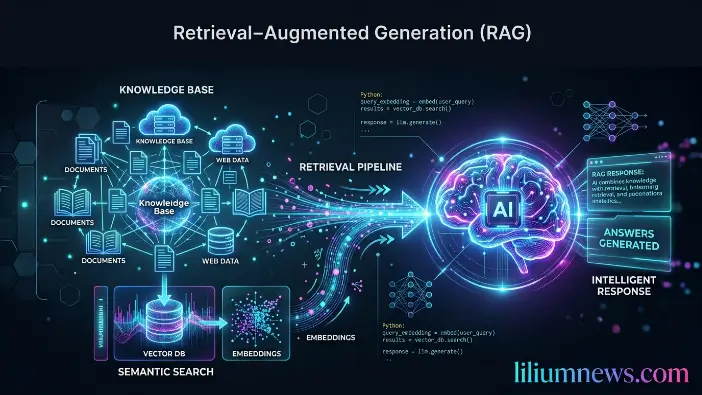
Welcome to Lilium News. Artificial intelligence has advanced rapidly with the development of large language models (LLMs) that can generate human-like text, answer questions, and assist with complex tasks. However, even powerful AI models have limitations, such as outdated knowledge and the tendency to generate incorrect information. This is where understanding what is rag in ai becomes important.
Retrieval-Augmented Generation (RAG) is a modern AI technique that improves the accuracy and reliability of AI responses by allowing language models to access external information sources before generating answers. Instead of relying only on previously trained data, RAG retrieves relevant information from databases, documents, or knowledge repositories and uses that information to create more accurate responses.
What Is RAG in AI?
RAG in AI stands for Retrieval-Augmented Generation, a technology that combines information retrieval with generative artificial intelligence to improve the quality and accuracy of AI-generated responses. Instead of depending only on the data used during training, RAG allows AI models to access external sources such as documents, databases, and knowledge repositories before creating an answer. This helps AI systems provide more relevant, updated, and context-aware information.
Understanding Retrieval-Augmented Generation
Retrieval-Augmented Generation is a framework that enhances large language models (LLMs) by adding a retrieval process before response generation. When a user submits a query, the system searches connected data sources to find relevant information and provides that context to the AI model. This allows the model to generate answers based on accurate external knowledge rather than relying only on its original training data.
The main purpose of RAG is to make AI systems more reliable and useful in real-world applications. By combining AI information retrieval, semantic search, and large language models, RAG helps reduce incorrect responses and improves the ability of AI tools to work with private, domain-specific, or frequently updated information. This makes it valuable for businesses, research platforms, customer support systems, and enterprise AI solutions.
Read Also: how to create ai images
How Does RAG Work in AI Systems?
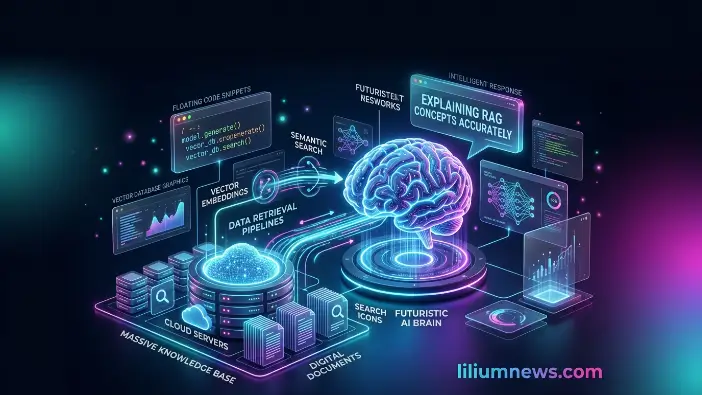
RAG in AI works by combining information retrieval techniques with generative AI models to provide more accurate and context-based responses. Instead of relying only on the knowledge stored inside a trained AI model, a RAG system searches external sources, retrieves relevant information, and uses that data to generate a better answer. This process allows AI applications to work with updated, private, and domain-specific information without requiring complete model retraining.
Step 1: Data Collection and Preparation
The first step in building a RAG system is collecting and organizing relevant information from different sources. These sources may include documents, websites, databases, research papers, customer support files, and internal company knowledge bases. The collected data is cleaned and structured so the AI system can process and retrieve useful information efficiently.
During this stage, data quality plays an important role in the performance of the system. Well-organized and accurate information helps improve retrieval results, while outdated or incorrect data can reduce response quality. Proper data preparation creates a strong foundation for AI knowledge retrieval and reliable AI-generated answers.
Step 2: Creating Vector Embeddings
After data preparation, the information is converted into numerical representations known as embeddings. These embeddings allow AI systems to understand the meaning, context, and relationships between different pieces of information rather than only matching exact words.
The generated embeddings are stored in a vector database, which enables fast and efficient searching. Through semantic search and vector databases, RAG systems can identify information that is conceptually related to a user’s question, even when the exact keywords are different.
Step 3: Information Retrieval
When a user enters a question, the RAG system analyzes the query and searches the connected knowledge sources to find the most relevant information. The retrieval process identifies documents, text sections, or data points that can help answer the user’s request.
The retrieved information is then added as context for the AI model. This step improves accuracy because the model receives relevant external knowledge before generating a response. By using information retrieval systems, RAG reduces the risk of AI hallucinations and helps create more trustworthy outputs.
Step 4: Response Generation
In the final step, the AI language model uses the user’s question along with the retrieved information to generate a response. The model combines its existing capabilities with the additional context provided by the RAG system to produce a more detailed and accurate answer.
This approach allows RAG in AI applications to deliver responses based on real-time and specialized information. By connecting large language models (LLMs) with external knowledge sources, RAG enables businesses, researchers, and developers to build smarter AI assistants that are more reliable and useful in practical situations.
Why Is RAG Important in Artificial Intelligence?
RAG in AI has become an important technology because it helps overcome some major limitations of traditional artificial intelligence systems. While large language models can generate impressive responses, they may sometimes provide outdated or inaccurate information because they depend mainly on their training data. RAG improves AI performance by connecting models with external knowledge sources, allowing them to access relevant information before generating answers.
Reduces AI Hallucinations
One of the biggest challenges in generative AI is hallucination, where an AI model produces incorrect or made-up information that appears convincing. This happens because traditional AI models may try to answer questions even when they do not have enough reliable information. RAG in AI helps reduce these errors by retrieving relevant data from trusted sources before generating a response.
Through AI accuracy improvement and context-based generation, RAG allows models to provide answers supported by real information. This makes AI systems more dependable, especially in areas where accuracy is critical, such as healthcare, finance, customer service, and research.
Provides Updated Information
AI models are usually trained on large datasets collected at a specific point in time, which means they may not know recent events, new products, or updated company information. RAG solves this limitation by allowing AI systems to access external databases and documents that can be updated regularly without retraining the entire model.
With real-time information retrieval, organizations can keep their AI applications current and relevant. For example, a business can update its product documentation or internal policies, and a RAG-powered AI assistant can immediately use that information to provide accurate responses.
Improves Business AI Applications
RAG has transformed how businesses use artificial intelligence by making AI tools more practical and customized. Companies can connect RAG systems with their own documents, databases, and knowledge platforms to create AI assistants that understand their specific operations and information.
Using enterprise AI solutions, businesses can improve customer support, automate internal searches, assist employees, and provide personalized experiences. Instead of building AI systems that rely only on general knowledge, RAG enables organizations to create smarter applications that deliver more relevant and valuable results.
RAG vs Traditional AI Models
RAG in AI and traditional AI models differ mainly in how they access and use information. Traditional AI models depend on the data they learned during the training process, which means their knowledge is limited to the information available at that time. If new information becomes available, these models usually require additional training or fine-tuning to improve their knowledge.
| Feature | Traditional AI Model | RAG-Based AI |
| Knowledge Source | Training data only | External data + training data |
| Updates | Requires retraining | Easy knowledge updates |
| Accuracy | May hallucinate | More context-based |
| Data Privacy | Depends on model | Can use private databases |
Real-World Applications of RAG
RAG in AI is being widely adopted across different industries because it allows artificial intelligence systems to access specific and updated information before generating responses. Unlike traditional AI applications that rely only on pre-trained knowledge, RAG-powered solutions can connect with external databases, documents, and knowledge sources to provide more accurate and useful results.
Customer Support AI Assistants
Customer support is one of the most common applications of RAG in AI. Businesses use RAG-powered chatbots and virtual assistants to provide customers with quick and accurate answers by accessing product documentation, FAQs, support tickets, and company policies.
Through AI-powered customer service, these assistants can understand customer questions and retrieve relevant information before responding. This helps reduce response times, improves customer satisfaction, and allows businesses to provide 24/7 support without depending entirely on human agents.
Healthcare Knowledge Systems
Healthcare organizations can use RAG systems to improve access to important medical information and research. AI-powered healthcare assistants can retrieve information from medical documents, research papers, clinical guidelines, and patient records to support professionals in finding relevant knowledge quickly.
With healthcare AI solutions and knowledge retrieval systems, RAG helps medical professionals analyze large amounts of information more efficiently. While it does not replace expert medical judgment, it can support decision-making by providing organized and relevant information when needed.
Education and Learning Platforms
RAG technology is transforming education by enabling personalized AI learning assistants. These systems can connect with textbooks, course materials, academic resources, and educational databases to provide students with accurate explanations and learning support.
Using personalized AI learning methods, RAG-powered platforms can answer questions based on specific study materials instead of providing generic responses. This creates a more interactive learning experience and helps students understand complex topics more effectively.
Enterprise Search Systems
Large organizations often store thousands of documents, reports, and internal resources, making it difficult for employees to find the right information quickly. RAG in AI helps solve this challenge by creating intelligent enterprise search systems that can understand questions and retrieve relevant company information.
With enterprise AI search and semantic search technology, employees can find documents, policies, and business insights using natural language queries. This improves productivity, reduces time spent searching for information, and allows companies to make better use of their internal knowledge.
Benefits of Using RAG in AI
RAG in AI provides a powerful way to improve the performance and reliability of artificial intelligence systems by allowing models to access external information before generating responses. Unlike traditional AI approaches, RAG combines retrieval-augmented generation with large language models to deliver more accurate, relevant, and context-aware answers. This makes RAG especially useful for businesses and organizations that need AI systems capable of working with updated and specialized information.
The key benefits of using RAG in AI include:
- Improved Accuracy: RAG helps AI models generate more reliable responses by using relevant external information instead of depending only on training data.
- Reduced AI Hallucinations: By grounding responses in trusted sources, RAG decreases the chances of AI producing incorrect or unsupported information.
- Access to Updated Information: RAG allows AI systems to use new data from connected databases and documents without requiring complete model retraining.
- Better Data Privacy: Organizations can connect RAG systems with private databases and internal documents while maintaining control over their information.
- Cost-Effective AI Updates: Updating knowledge sources is usually faster and more affordable than retraining a large AI model.
- Enhanced Personalization: RAG enables AI applications to provide customized responses based on specific business data, user needs, or industry knowledge.
Challenges and Limitations of RAG
Although RAG in AI offers many advantages, it also comes with certain challenges that can affect the performance and reliability of AI systems. Since RAG depends on external knowledge sources, retrieval processes, and complex AI infrastructure, organizations need to carefully manage data quality, system design, and technical implementation. Understanding these limitations helps businesses create more effective retrieval-augmented generation solutions.
Data Quality Problems
The quality of information used by a RAG system directly affects the quality of its responses. If the connected documents, databases, or knowledge sources contain outdated, incomplete, or incorrect information, the AI model may retrieve unreliable data and generate inaccurate answers.
Maintaining high-quality data is essential for successful AI knowledge retrieval. Organizations need to regularly review, update, and organize their information sources to ensure that the RAG system provides accurate and trustworthy responses.
Retrieval Accuracy Issues
A RAG system depends on its ability to find the most relevant information from large datasets. If the retrieval process selects irrelevant documents or misses important details, the AI model may produce responses that are incomplete or less accurate.
Improving semantic search capabilities, optimizing document organization, and using better retrieval methods can help solve these issues. Effective retrieval ensures that the AI model receives the right context before generating an answer.
Technical Complexity
Building and maintaining a RAG system requires technical expertise in areas such as data processing, embedding models, vector databases, and AI model integration. Setting up a reliable retrieval pipeline can be challenging, especially for organizations with limited AI development resources.
Managing vector databases, large language models (LLMs), and retrieval workflows requires careful planning and continuous optimization. Without proper implementation, a RAG system may not deliver the accuracy and efficiency expected from modern AI applications.
How to Build a Simple RAG System
Building a simple RAG in AI system involves connecting a retrieval process with a large language model to help AI applications access external knowledge and generate more accurate responses. A basic RAG pipeline collects relevant information, converts it into a format that AI can understand, stores it for quick retrieval, and then combines the retrieved data with an AI model to create meaningful answers. By following these steps, developers can create AI applications that use customized knowledge sources instead of depending only on pre-trained information.
Step 1: Collect Your Data
The first step in creating a RAG system is gathering the information that the AI model will use to answer user questions. This data can come from different sources, including documents, websites, company files, databases, product manuals, and research materials.
The collected information should be relevant, accurate, and well-organized because the quality of the data directly impacts the performance of the system. Proper data collection creates a strong foundation for AI knowledge retrieval and ensures that the RAG application can provide useful responses.
Step 2: Convert Data Into Embeddings
After collecting the data, the next step is converting text and other information into numerical representations called embeddings. These embeddings help AI systems understand the meaning and relationships between different pieces of information.
Using AI embeddings allows the system to compare user queries with stored information based on meaning rather than only matching keywords. This process improves search accuracy and helps the RAG system find the most relevant content when responding to users.
Step 3: Store Data in a Vector Database
Once the data has been converted into embeddings, it is stored in a vector database. A vector database is designed to store and search large amounts of AI-generated data efficiently.
Through vector database technology and semantic search, the RAG system can quickly identify relevant information when a user submits a question. This makes the retrieval process faster and helps the AI model access the right context before generating a response.
Step 4: Connect Retrieval With an LLM
The next step is connecting the retrieval system with a large language model (LLM). When a user asks a question, the system first retrieves relevant information from the vector database and then sends that information to the AI model along with the original query.
The LLM uses this additional context to create a more accurate and detailed answer. This combination of retrieval and generation is what makes retrieval-augmented generation more powerful than a standard AI model that only relies on its training data.
Step 5: Test and Improve Responses
The final step is testing the RAG system and improving its performance. Developers need to evaluate the quality of generated responses, check retrieval accuracy, and identify areas where the system needs improvement.
Regular testing helps optimize data sources, prompts, retrieval settings, and AI model performance. By continuously improving the system, organizations can build reliable RAG in AI applications that deliver accurate, relevant, and user-focused results.
Common RAG Implementation Mistakes
While RAG in AI can significantly improve the accuracy and usefulness of AI applications, poor implementation can reduce its effectiveness. Many organizations face problems because they focus only on connecting a retrieval system with an AI model without properly managing data quality, retrieval processes, and system optimization. Avoiding common mistakes helps create a more reliable retrieval-augmented generation system that delivers accurate and relevant responses.
Common RAG implementation mistakes include:
- Using Poor-Quality Data: A RAG system depends on the information it retrieves. Using outdated, incomplete, or inaccurate documents can lead to incorrect AI responses. Organizations should regularly review and update their knowledge sources to maintain reliable results.
- Incorrect Document Chunking: Large documents need to be divided into smaller sections before being stored for retrieval. Poor chunking strategies can remove important context or make it difficult for the system to find relevant information.
- Ignoring Retrieval Performance: A RAG system is only effective if it retrieves the right information. Failing to test and optimize semantic search and retrieval settings can result in irrelevant answers.
- Adding Too Much Unnecessary Context: Providing excessive information to the AI model can reduce response quality and increase processing costs. The system should retrieve only the most relevant data needed to answer a query.
- Not Monitoring AI Responses: Continuous evaluation is important for maintaining accuracy. Organizations should monitor AI outputs, identify errors, and improve the retrieval process over time.
- Choosing the Wrong AI Model: Selecting an unsuitable large language model (LLM) or embedding model can affect performance. The chosen models should match the specific goals, data requirements, and complexity of the RAG application.
Frequently Asked Questions About RAG in AI
Can RAG work with private company data?
Yes, RAG in AI can be connected with private company documents, databases, and internal knowledge systems, allowing organizations to build customized AI solutions while keeping their data under control.
Does RAG replace the need for training AI models?
No, RAG does not replace AI model training. Instead, it enhances existing models by providing additional information from external sources when generating responses.
What programming skills are needed to create a RAG application?
Building a RAG application usually requires knowledge of AI frameworks, databases, APIs, and programming languages such as Python, along with an understanding of machine learning concepts.
How is RAG different from a normal search engine?
A search engine mainly finds and displays information, while RAG uses retrieved information to generate complete, conversational answers using an AI model.
Is RAG suitable for small businesses?
Yes, small businesses can use RAG to create affordable AI assistants for customer support, document management, and internal knowledge sharing without developing a new AI model from scratch.
Conclusion
Understanding what is rag in ai helps explain how modern artificial intelligence systems are becoming more accurate, flexible, and reliable. Retrieval-Augmented Generation improves AI performance by allowing models to access external knowledge sources before generating responses, making answers more relevant and based on real information.
Unlike traditional AI models that depend only on training data, RAG systems can work with updated documents, private databases, and specialized information without requiring complete retraining. By combining AI knowledge retrieval, semantic search, and large language models, RAG enables businesses and organizations to create smarter AI applications for customer support, research, education, and enterprise solutions.
