


Welcome to Lilium News. Artificial intelligence has evolved rapidly, and generative AI has become one of the most transformative technologies in recent years. From creating human-like text and generating images to writing computer code and analyzing complex information, modern AI systems rely heavily on advanced models that can understand and produce different types of content. A key technology behind these systems is the foundation model.
Understanding what are foundation models in generative ai? is important for anyone interested in artificial intelligence, machine learning, or the future of technology. These models serve as the core building blocks behind many popular AI applications, allowing developers to create powerful tools without building every AI system from scratch.
What Are Foundation Models in Generative AI?
Foundation models in generative AI are large-scale artificial intelligence models trained on massive amounts of data to understand patterns, generate content, and perform multiple tasks. Unlike traditional AI models designed for a single purpose, foundation models act as a flexible base that can be adapted for different applications, including text generation, image creation, coding assistance, and advanced data analysis. These models are the core technology behind many modern generative AI systems because they provide powerful capabilities that can be customized for specific needs.
Understanding the Foundation Model Concept
A foundation model is a pre-trained AI system that learns from diverse datasets, such as text, images, audio, and code, to develop a broad understanding of information. These models use advanced machine learning models and deep learning techniques to identify patterns and relationships within data. Once trained, they can be adjusted through fine-tuning or prompting to perform specialized tasks without requiring developers to build a completely new AI system from the beginning.
The main advantage of foundation models is their ability to support multiple applications with a single powerful model. For example, a language-based foundation model can help create content, answer questions, translate languages, and generate code. This flexibility has made foundation models an essential part of modern artificial intelligence development, allowing organizations to create smarter and more efficient AI solutions.
How Foundation Models Power Generative AI
Foundation models provide the underlying intelligence that enables generative AI systems to create new content. They analyze user inputs, recognize patterns learned during training, and generate responses based on their understanding of data. Whether an AI system is producing text, creating images, writing software code, or generating audio, foundation models help transform simple instructions into meaningful outputs.
Modern generative AI models rely heavily on foundation models because they can handle complex tasks across different fields. Businesses use these models for automation, customer support, research, and content creation, while developers use them to build advanced AI applications. As foundation models continue to improve, they are expanding the possibilities of natural language processing (NLP), multimodal AI, and intelligent automation.
How Do Foundation Models Work?
Foundation models in generative AI work by using advanced artificial intelligence techniques to learn patterns, relationships, and structures from massive amounts of data. These models are trained through a complex process that involves collecting high-quality datasets, building powerful neural networks, applying transformer architecture, and adapting the model for specific applications. This process allows foundation models to generate human-like text, create images, write code, and support many other generative AI applications.
Step 1: Collecting and Preparing Training Data
The first step in creating a foundation model is collecting and preparing large amounts of training data. These datasets may include text from books and websites, images, videos, audio files, scientific research, and programming code. The model uses this information to learn patterns and relationships that help it understand and generate new content.
Before training begins, the collected data goes through a preparation process to improve quality and accuracy. This includes removing duplicate information, filtering unreliable content, organizing datasets, and reducing harmful or irrelevant data. High-quality training data plays an important role in improving the performance of machine learning models because the model’s knowledge depends heavily on the information it learns from.
Step 2: Training Neural Networks
After preparing the data, the next step involves training complex neural networks. Neural networks are computing systems inspired by the structure of the human brain that allow AI models to recognize patterns and make predictions. During training, the foundation model analyzes billions of examples and gradually learns how different pieces of information are connected.
The training process requires powerful computing resources, including specialized hardware and advanced algorithms. Through repeated learning cycles, the model improves its ability to understand language, images, and other forms of data. This stage helps create a powerful deep learning system capable of performing multiple tasks instead of being limited to one specific function.
Step 3: Using Transformer Architecture
Most modern foundation models rely on transformer architecture, a technology that allows AI systems to process and understand complex relationships within data. Transformers use a mechanism called attention, which helps the model identify the most important parts of information when generating an output.
For example, in language-based foundation models, transformer architecture helps the AI understand the meaning of words based on their context rather than looking at each word separately. This advancement has significantly improved natural language processing (NLP) and enabled AI systems to generate more accurate, relevant, and human-like responses.
Step 4: Fine-Tuning for Specific Tasks
Once a foundation model is trained, it can be customized for specific tasks through a process called fine-tuning. Fine-tuning involves training the existing model with additional specialized data so it can perform better in a particular area or industry.
For example, a general foundation model can be adapted for healthcare research, financial analysis, customer service, or software development. Fine-tuning allows organizations to create specialized AI solutions while saving time and resources compared to building a new model from scratch. This flexibility is one of the main reasons why generative AI models powered by foundation models are becoming widely used across different industries.
Read Also: Who is the father of ai
Types of Foundation Models
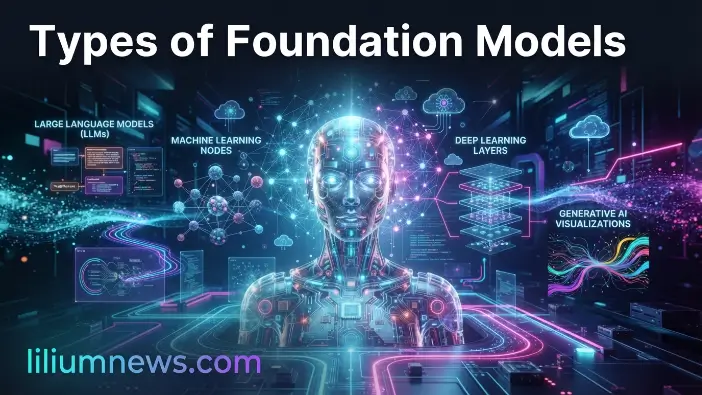
Foundation models in generative AI come in different types depending on the kind of data they process and the tasks they are designed to perform. While some models specialize in understanding and generating text, others focus on images, multiple data formats, or computer programming. These different categories allow organizations to use AI models for a wide range of applications, from content creation and research to software development and automation.
Large Language Models (LLMs)
Large Language Models (LLMs) are one of the most popular types of foundation models designed to understand and generate human-like text. These models are trained on massive collections of written content, allowing them to learn language patterns, context, reasoning abilities, and relationships between words. Popular examples include GPT-based models, Claude, Gemini, and other advanced natural language processing (NLP) systems.
LLMs power many modern AI applications, including chatbots, writing assistants, translation tools, and research platforms. They can perform tasks such as answering questions, summarizing documents, creating content, and generating computer code. Because of their ability to process and produce natural language, LLMs have become a major part of today’s generative AI models.
Vision Foundation Models
Vision foundation models are designed to understand, analyze, and generate visual information such as images and videos. These models are trained on large image datasets, allowing them to recognize objects, identify patterns, interpret scenes, and create new visual content based on user instructions.
These models are widely used in areas such as healthcare imaging, autonomous vehicles, security systems, and creative design. For example, vision foundation models can help doctors analyze medical scans, assist businesses with visual search, or generate realistic images from text descriptions. They represent an important advancement in computer vision and AI-powered image processing.
Multimodal Foundation Models
Multimodal foundation models are advanced AI systems that can process and combine multiple types of information, including text, images, audio, and video. Unlike single-purpose models that focus on one type of data, multimodal models can understand connections between different formats and provide more comprehensive responses.
For example, a multimodal AI model can analyze an image, explain what it contains, answer questions about it, and create related text content. These capabilities make multimodal foundation models useful for virtual assistants, education platforms, research tools, and advanced artificial intelligence systems that require deeper understanding across different data types.
Code Foundation Models
Code foundation models are specialized AI models trained on large amounts of programming data, including software code, documentation, and development resources. These models are designed to help programmers write, understand, and improve code more efficiently.
Developers use code foundation models for tasks such as generating functions, detecting programming errors, explaining complex code, and creating documentation. By supporting software development workflows, these models improve productivity and make programming more accessible. As AI technology continues to evolve, code foundation models are becoming an important part of modern AI development and software engineering.
Applications of Foundation Models in Generative AI
Foundation models in generative AI are transforming how individuals, businesses, and industries use artificial intelligence to solve problems and create new solutions. Because these models can understand large amounts of information and generate different types of content, they are being applied across multiple fields, including content creation, healthcare, business operations, and software development. Their flexibility allows organizations to build smarter AI applications without developing separate models for every individual task.
Content Creation
Foundation models have significantly changed the way digital content is created by helping users generate written, visual, and multimedia content quickly. AI-powered tools can assist with creating blog posts, marketing materials, social media content, product descriptions, video scripts, and other creative assets. These systems analyze patterns from existing data and use their learned knowledge to produce relevant and engaging outputs.
Content creators, marketers, and businesses use these generative AI models to improve productivity and streamline creative workflows. Instead of replacing human creativity, foundation models act as intelligent assistants that help with brainstorming ideas, improving writing quality, generating designs, and adapting content for different audiences.
Healthcare and Research
Foundation models are creating new opportunities in healthcare and scientific research by helping professionals analyze complex information and discover valuable insights. These models can process medical documents, research papers, patient information, and scientific data to support faster decision-making and knowledge discovery.
In healthcare, foundation models can assist with medical image analysis, drug discovery, disease research, and clinical documentation. Researchers also use AI systems to identify patterns in large datasets and accelerate scientific discoveries. By combining machine learning models with expert knowledge, foundation models have the potential to improve efficiency and innovation in healthcare and research environments.
Business Automation
Businesses are using foundation models to automate repetitive tasks, improve customer experiences, and increase operational efficiency. These models can power AI chatbots, virtual assistants, document analysis tools, and automated reporting systems that help organizations save time and resources.
For example, companies can use foundation models to handle customer inquiries, summarize business documents, analyze market information, and generate reports. By integrating artificial intelligence into daily operations, businesses can improve decision-making and provide more personalized services to customers.
Software Development
Foundation models are also changing the software development process by assisting programmers with writing, testing, and improving code. Code-focused foundation models can generate programming solutions, explain complex code, identify errors, and help developers complete projects faster.
Developers use these AI-powered tools to increase productivity and reduce time spent on repetitive coding tasks. These models can support beginners learning programming as well as experienced engineers working on complex software projects. As AI development continues to advance, foundation models are becoming an essential part of modern software engineering workflows.
Benefits of Foundation Models
Foundation models in generative AI provide several advantages that have changed how artificial intelligence systems are created and used. These models allow developers and organizations to build powerful AI solutions with greater flexibility, efficiency, and scalability. By learning from massive datasets and supporting multiple tasks, foundation models help improve the performance of AI systems across different industries and applications.
Improved AI Capabilities
One of the biggest benefits of foundation models is their ability to deliver advanced AI capabilities. Because these models are trained on large and diverse datasets, they can understand complex patterns, generate accurate responses, and perform a wide range of tasks. This allows AI systems to handle activities such as language understanding, image analysis, content generation, and problem-solving more effectively.
Foundation models also support advanced features such as reasoning, contextual understanding, and multimodal processing. These improvements help create more intelligent generative AI models that can interact with users in a more natural and useful way.
Faster AI Development
Foundation models significantly reduce the time and resources required to develop new AI applications. Instead of creating and training a separate model from the beginning for every task, developers can start with an existing foundation model and customize it according to their specific requirements.
This approach makes AI development faster, more affordable, and more accessible. Businesses and researchers can use pre-trained models, apply fine-tuning techniques, and build specialized solutions without investing in the enormous computing power and data collection needed to train a completely new model.
Better User Experiences
Foundation models help create more personalized and efficient user experiences by allowing AI systems to better understand user needs and provide relevant responses. They power applications such as intelligent chatbots, virtual assistants, recommendation systems, and content generation platforms.
With improved language understanding and contextual awareness, these models can provide more natural conversations and accurate results. This makes artificial intelligence tools easier to use and more valuable for individuals, businesses, and organizations.
Reduced Need for Training Separate Models
A major advantage of foundation models is that they reduce the need to train separate AI models for every individual task. Traditional AI development often required building specialized models for specific purposes, which required significant time, data, and technical expertise.
With foundation models, a single powerful model can be adapted for multiple applications through methods such as prompting and fine-tuning. This approach improves efficiency, reduces development costs, and allows organizations to create different machine learning solutions using the same underlying technology.
Challenges and Limitations of Foundation Models
Foundation models in generative AI have introduced powerful capabilities, but they also come with several challenges and limitations. Building and deploying these advanced artificial intelligence systems requires significant resources, careful management, and responsible development practices. Issues related to cost, fairness, accuracy, privacy, and environmental impact must be addressed to ensure that foundation models are used safely and effectively.
High Training Costs
One of the biggest challenges of foundation models is the high cost involved in training and maintaining them. These models require massive amounts of data, powerful computing infrastructure, and specialized hardware to process billions of parameters during training. The development process can require significant financial investment and technical expertise.
The ongoing costs do not end after training. Organizations also need resources for model updates, security improvements, testing, and deployment. Because of these requirements, smaller companies and researchers may face difficulties accessing advanced machine learning models compared to large technology organizations with greater resources.
Bias and Fairness Issues
Foundation models learn patterns from the data they are trained on, which means they can sometimes inherit biases or unfair patterns present in their training datasets. If the data contains stereotypes, inaccurate information, or limited perspectives, the model may produce outputs that reflect these issues.
Addressing bias requires careful dataset selection, continuous testing, and responsible AI development practices. Developers must evaluate models regularly to improve fairness and ensure that generative AI models provide useful and balanced results for different groups of users.
Accuracy and Hallucination Problems
Although foundation models can generate highly realistic responses, they are not always completely accurate. Sometimes, these models may produce incorrect information, create unsupported facts, or provide misleading answers. This issue is commonly known as AI hallucination.
Hallucinations occur because AI models generate responses based on learned patterns rather than a true understanding of the world. To reduce these problems, organizations use techniques such as improved training data, human review, fact-checking systems, and advanced model evaluation methods.
Data Privacy Concerns
Foundation models often require large datasets for training, which creates concerns about data privacy and security. If sensitive or personal information appears in training data, there is a risk that the model may unintentionally expose or misuse that information.
Organizations must follow responsible data practices by protecting user information, following privacy regulations, and implementing strong security measures. Proper data management helps ensure that AI systems are developed and used in a safe and ethical way.
Environmental Impact
Training large foundation models requires significant computational power, which can consume large amounts of energy. The use of thousands of advanced processors during training and operation can contribute to higher energy consumption and environmental concerns.
Researchers and technology companies are working on solutions such as smaller, efficient models, improved hardware, and optimized training methods. Developing more sustainable deep learning approaches will be important for reducing the environmental impact of future foundation models while maintaining their capabilities.
Future of Foundation Models in Generative AI
The future of foundation models in generative AI is expected to bring more advanced, efficient, and accessible artificial intelligence solutions across industries. As research continues, these models will become more powerful while requiring fewer resources. Future developments will focus on improving accuracy, reducing costs, increasing safety, and creating AI systems that can better understand and interact with humans.
Key future trends in foundation models include:
- More Advanced Multimodal AI: Future foundation models will become better at processing and combining text, images, audio, and video, enabling more intelligent and interactive AI applications.
- Smaller and More Efficient Models: Researchers are developing lightweight AI models that can deliver strong performance while using less computing power and energy.
- Industry-Specific AI Solutions: Foundation models will become more specialized for industries such as healthcare, finance, education, and legal services, providing more accurate and relevant results.
- Improved AI Reasoning Capabilities: Future models will focus on better problem-solving, logical thinking, and understanding complex tasks beyond simple content generation.
- Growth of AI Agents: Foundation models will support advanced AI agents capable of completing tasks independently, managing workflows, and assisting users in real-world scenarios.
- Greater Focus on Responsible AI: Future development will prioritize fairness, transparency, privacy protection, and reducing harmful outputs to create safer artificial intelligence systems.
Common Mistakes People Make About Foundation Models
Foundation models in generative AI are advanced technologies, but people often misunderstand their abilities and limitations. Knowing these common mistakes helps users use AI systems more effectively.
- Assuming AI Understands Like Humans: Foundation models recognize patterns in data but do not think or understand like humans.
- Thinking Bigger Models Are Always Better: A larger model does not always mean better results; accuracy also depends on data quality and training methods.
- Ignoring Data Quality: Poor training data can lead to inaccurate or biased AI outputs.
- Expecting Perfect Accuracy: Foundation models can make mistakes, so important information should always be verified.
- Overlooking Ethical and Privacy Concerns: Users should consider data security, privacy, and responsible AI usage when applying these models.
Frequently Asked Questions
Why are foundation models important for the future of artificial intelligence?
Foundation models provide a flexible base for building advanced AI applications, helping organizations create smarter solutions with less development time and resources.
Can small businesses use foundation models without advanced AI knowledge?
Yes, many AI platforms allow businesses to use foundation models through simple tools and interfaces without requiring deep technical expertise.
How do foundation models improve decision-making?
Foundation models can analyze large amounts of information quickly and identify patterns that help individuals and organizations make more informed decisions.
Are foundation models only useful for technology companies?
No, foundation models are used across industries such as education, healthcare, finance, marketing, and customer service to improve efficiency and innovation.
What skills are needed to work with foundation models?
Working with foundation models requires knowledge of AI concepts, data handling, prompt design, and sometimes programming skills for advanced customization.
Conclusion
Foundation models in generative AI have become a powerful foundation for modern artificial intelligence by enabling machines to understand, create, and process different types of information. These models support a wide range of applications, from content creation and business automation to healthcare research and software development. Their ability to perform multiple tasks makes them one of the most important advancements in the field of AI.
As technology continues to evolve, foundation models will become more efficient, accurate, and accessible. While challenges such as cost, privacy, bias, and reliability still need attention, ongoing research is helping create safer and more responsible AI systems. Understanding what are foundation models in generative AI allows individuals and businesses to better prepare for the future of artificial intelligence and take advantage of the opportunities these technologies provide.
