


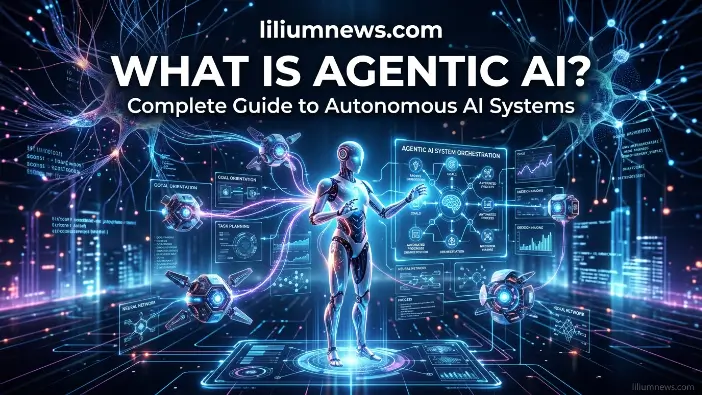
what is agentic ai is an advanced form of artificial intelligence that goes beyond simply answering questions. Instead of waiting for step-by-step instructions, it can understand an overall goal and determine how to achieve it. It can analyze a situation, plan the required steps, and decide how to move forward. In simple terms, it works more like an independent digital system than a passive tool. For example, if you ask it to “grow an online business,” it may divide the goal into tasks such as market research, content creation, marketing, and performance tracking. This goal-oriented approach is the main idea behind what agentic AI is.
Another key part of what agentic AI is is its ability to take action and adjust its decisions over time. After creating a plan, it can complete tasks with available tools, review the results, and improve its next steps based on feedback. This creates a cycle of planning, action, and learning, similar to how people handle complex projects. Because of this, agentic AI is often viewed as a step toward automated digital assistants that can manage real-world tasks with limited human input. It combines reasoning, memory, and action, making it more capable than traditional AI systems that mainly generate responses.
What is agentic AI?
Agentic AI is an advanced type of artificial intelligence that can understand a goal and work independently toward achieving it. Unlike traditional AI systems that mainly respond to questions or commands, agentic AI can plan tasks, make decisions, and take actions on its own. It does more than provide information because it actively works toward completing a task. This makes it similar to a digital assistant that can plan and perform work rather than simply provide answers.
Meaning of Agentic AI
The meaning of agentic AI comes from the word “agent,” which refers to something capable of acting independently to achieve a goal. In AI, an agentic system is designed to act on behalf of a user instead of only responding to requests. In simple terms, agentic AI means AI that understands what you want and determines how to accomplish it.
For example, instead of only explaining how to start a business, it can divide the process into steps such as research, planning, and execution. This ability to act with a clear purpose makes it different from standard AI tools. Independence is also important because agentic AI does not require constant instructions for every individual step. Once it understands the goal, it can continue working until the task is completed or needs further improvement.
Key idea behind Agentic AI
The key idea behind agentic AI is goal-driven autonomy, meaning the AI focuses on achieving an outcome rather than simply generating responses. It works through a step-by-step process. First, it understands the goal provided by the user. Then, it creates a plan by dividing that goal into smaller tasks.
After planning, it takes action using available tools or information sources. It then reviews the results and adjusts its next steps when necessary. This ongoing process helps it manage complex tasks in a more human-like way. Adaptability is another important feature. If conditions change during a task, agentic AI can modify its plan instead of stopping. This makes agentic AI more capable than traditional systems when dealing with unpredictable, real-world tasks.
Read Also: ai se content kaise banaye
How agentic AI works

Agentic AI operates through a structured process that begins by understanding a user’s goal, followed by planning, executing actions, and improving based on the results. Unlike traditional AI that may provide a single response, it can continue working toward a specific objective. This makes it more capable because it brings reasoning, planning, and action together within one system that functions like an intelligent digital agent.
Step 1 – Understanding goals
The first stage of agentic AI is understanding the user’s goal. At this point, the AI does not view the input as just a simple question. Instead, it interprets the request as a broader objective that may contain several tasks. It attempts to identify what the user actually wants to accomplish rather than focusing only on the exact wording of the prompt. This deeper understanding helps the system prepare for tasks that require multiple steps. For example, if a user says “grow my online business,” the AI recognizes that the request involves more than providing one answer.
It may understand that the objective involves marketing, content creation, customer targeting, and performance monitoring. By examining the context and intent, agentic AI develops a clearer view of the desired result before taking action. It also considers available information, limitations, tools, and resources that may be required. This helps the system move from basic interpretation to practical planning.
Step 2 – Planning actions
After understanding the goal, agentic AI enters the planning stage, where it divides the main objective into smaller and organized tasks. This stage is important because complex goals usually require several actions instead of one step. The AI creates a structured roadmap that places tasks in a logical sequence. For example, if the goal is to “build an app,” it may divide the process into tasks such as planning features, designing the user interface, developing the code structure, and testing functionality.
Each task becomes a manageable part of the overall objective and contributes to the outcome. This type of structured planning is similar to how a project manager organizes a large project. During this stage, agentic AI can also determine task order and identify dependencies. It understands which steps should happen first and which can follow later. This helps maintain a smooth workflow and can reduce errors during execution.
Step 3 – Executing tasks
During the execution stage, agentic AI begins carrying out the planned actions with available tools, systems, or integrations. Unlike traditional AI that mainly provides recommendations, agentic AI can actively perform tasks. These may include collecting information, creating content, interacting with software, or automating digital workflows. For example, when handling research, it can gather information from different sources, organize the findings, and produce structured results.
When automation is involved, it can trigger actions across connected applications. This allows agentic AI to function more like a digital worker rather than simply an assistant. While performing tasks, the system can monitor its progress and identify potential problems. If an error occurs, it may change its approach or use another available method. This flexibility helps the workflow continue even when unexpected challenges occur.
Step 4 – Learning from results
The final stage of agentic AI is learning from the results. After completing a task, the AI evaluates whether the outcome matches the original goal. It examines what worked effectively and identifies areas that may need improvement. This feedback loop helps the system improve its accuracy and efficiency over time. The process can continue across different tasks, allowing the AI to refine its performance through experience.
It can improve its decision-making, planning methods, and execution strategies based on previous outcomes. Over time, this can make agentic AI more effective when dealing with complex real-world tasks. In simple terms, this stage allows the system to use feedback and experience to improve future actions, making it more adaptable than a fixed-response tool.
Difference Between Agentic AI and Traditional AI
The difference between agentic AI and traditional AI mainly involves how they operate, their level of independence, and how they complete tasks. Traditional AI systems generally follow predefined rules or respond to prompts, while agentic AI can understand goals, create plans, and perform actions. This allows agentic AI to handle multi-step tasks more independently rather than simply reacting to individual requests.
Table Comparison: Traditional AI vs Generative AI vs Agentic AI
| Feature | Rule-based AI | Generative AI (ChatGPT) | Agentic AI |
| Working Style | Rule-based | Response-based | Goal-based |
| Independence | None | Low | High |
| Decision Making | No | Limited | Advanced |
| Task Execution | No | Partial | Full |
| Ability to Act | No | No | Yes |
| Learning Ability | Very limited | Moderate | Continuous |
| Example | Script-based chatbots | ChatGPT | Autonomous AI agents |
Real-World Examples of what is agentic AI
Agentic AI is increasingly being used in systems where AI can do more than answer questions and can actively complete tasks. These systems are designed to operate as digital agents that can plan, make decisions, and perform actions with limited human involvement. The following examples show how agentic AI can be applied across different real-world areas.
AI personal assistants
AI personal assistants are a common example of what agentic AI is. These assistants can go beyond basic voice commands and chat responses. Instead of only providing information, they can help with tasks such as scheduling meetings, setting reminders, organizing emails, and recommending useful actions based on available information.
For example, an advanced AI assistant may check a calendar, identify available time, schedule a meeting, and make adjustments when conflicts occur. This demonstrates how agentic AI can perform tasks with greater independence and reduce manual effort in daily activities. As these systems develop, they may also become more proactive by identifying useful actions without requiring a separate request for every step.
Autonomous business agents
Autonomous business agents are another example of agentic AI being used in business environments. These AI systems can support processes such as marketing, customer service, data analysis, and business operations. For example, an AI agent may monitor sales performance, identify an issue, and recommend or perform an action such as changing a campaign or adjusting a business process.
It can also create reports and provide insights to managers without requiring every task to be requested manually. This type of automation demonstrates how agentic AI can reduce repetitive work and support businesses in managing operational and analytical tasks more efficiently.
Robotics and automation systems
Robotics is another important application of agentic AI. In factories and warehouses, intelligent robots can perform tasks such as assembling products, sorting items, and managing inventory with limited human supervision. These systems can respond to changes around them instead of simply following one fixed sequence of instructions.
They can detect problems, evaluate their surroundings, and adjust their actions when necessary. For example, if an item is incorrectly positioned on a production line, an intelligent robot may identify the issue and modify its action. This ability to sense, decide, and act shows how agentic AI can be applied to physical environments.
AI workflow automation tools
AI workflow automation tools are another digital example of what agentic AI is. These tools can connect different applications and automate multi-step processes such as data entry, email handling, reporting, and file management.
For example, an AI system can collect information from emails, enter it into a spreadsheet, analyze the data, and prepare a summary report for a team. It can complete several connected steps while making decisions during the workflow. This shows how agentic AI can manage complete digital processes instead of handling only one isolated action, helping businesses create faster and more organized workflows.
Key Features of Agentic AI
Agentic AI becomes more capable through several features that allow it to operate independently, make decisions, and improve its performance. Unlike traditional AI systems that mainly respond to commands, agentic AI is designed to reason, plan, and act toward specific goals. This makes it useful for handling multi-step tasks rather than simply providing information. Its capabilities come from combining autonomy, goal orientation, reasoning, adaptability, and continuous improvement.
Autonomy
Autonomy in agentic AI means the system can work independently without requiring constant human instructions. Once it receives a goal, it can continue completing tasks without needing approval for every individual action. This allows it to manage complex workflows without waiting for repeated commands.
- Agentic AI can work like a self-operating assistant with less need for constant supervision.
- It can independently organize and process large amounts of data.
- It can generate and send reports without instructions for every step.
- It can manage complete workflows from beginning to end.
- It reduces human involvement in repetitive and time-consuming tasks.
- It can save time by automating multi-step processes.
- It can improve speed, consistency, and efficiency during task completion.
- It is useful in applications where automation and productivity are important.
Goal orientation
Goal orientation in agentic AI means the system focuses on achieving a specific result instead of only responding to questions or prompts. It can continue working toward the broader objective rather than stopping after providing information. This makes it focused on completing outcomes across multiple steps.
- If the goal is to “launch a marketing campaign,” agentic AI does more than simply provide ideas.
- It first identifies and understands the overall objective.
- It divides the main goal into organized steps, such as:
- Audience research
- Content planning
- Ad creation
- Performance tracking
- It then follows these tasks in a logical sequence.
- It continues working toward the desired final result.
- This focus on completing broader tasks makes what is agentic AI useful for practical, multi-step workflows.
Reasoning ability
Reasoning ability in what is agentic AI means the system can analyze situations and make structured decisions. It can consider different options, evaluate possible outcomes, and select actions based on the information available. This helps it approach complex problems in an organized way instead of simply reacting to input.
- In simple terms, agentic AI follows a logical process instead of acting without direction.
- It can work through problems step by step.
- It uses available information and reasoning to support its decisions.
- If one approach fails, it can identify the problem.
- It may then try another suitable method.
- It can change decisions when new information becomes available.
- This can make its performance more flexible and consistent.
- It supports structured problem-solving across complex tasks.
Adaptability
Adaptability in agentic AI means the system can adjust its behavior when new information or changing conditions affect a task. Because real-world situations can be unpredictable, this ability helps the AI respond without being limited to one fixed process. It can modify its approach when the original plan is no longer suitable.
- If a task changes during execution or new information becomes available, agentic AI can adjust its plan.
- It does not always need to restart the entire process.
- It can update existing steps according to new conditions.
- It can choose alternative approaches when required.
- It can continue working toward the final objective while adapting to changes.
- This flexibility makes what is agentic AI useful in changing real-world environments.
- It can handle complex tasks where conditions may change during execution.
Continuous learning
Continuous learning in agentic AI refers to improving performance through feedback, results, and previous experiences. The system can examine which actions produced useful outcomes and use that information to improve future decisions. This process can help make planning and execution more effective over time.
- In simple terms, agentic AI can use feedback to refine its performance over time.
- It can learn from the outcomes of tasks it performs.
- It can identify successful approaches and areas that need improvement.
- It can use feedback to refine future planning, reasoning, and execution.
- Over time, it can develop more effective strategies.
- This can improve its ability to handle complex tasks.
- It is designed to improve rather than remain limited to one fixed response pattern.
- As it receives useful feedback, agentic AI can become more effective at completing future tasks.
Benefits of agentic AI
Agentic AI offers several benefits because it can understand goals, work independently, and complete multi-step tasks with limited human involvement. Instead of only generating answers, it can perform actions, manage workflows, and use feedback to improve results. These capabilities can be useful in industries where automation, efficiency, and productivity are important.
Saves time
One major benefit of agentic AI is its ability to save time by automating complex tasks that may otherwise require significant manual effort. Once a goal is provided, it can plan and perform multiple steps without waiting for continuous instructions. This can reduce delays and speed up workflows.
- Agentic AI can handle research tasks quickly.
- It can automatically prepare detailed reports.
- It can organize large amounts of information into structured formats.
- It can complete multi-step workflows more quickly.
- It can divide complex objectives into manageable tasks.
- It can continue working without requiring regular breaks.
- It can reduce the need for constant human supervision.
- It can perform tasks faster than many manual processes.
- It can improve overall workflow speed and efficiency.
Improves productivity
Agentic AI can improve productivity by managing multiple tasks and supporting continuous workflows. It can handle different parts of a process, helping increase output while reducing the amount of routine work people need to perform. This gives individuals and businesses more time to focus on higher-value activities.
- Agentic AI can help people focus on strategic and higher-level decisions.
- It reduces time spent on repetitive and routine activities.
- It can automate data processing tasks.
- It can also support content creation and other digital workflows.
- While AI handles routine work, people can focus on strategy and planning.
- This creates a practical balance between human skills and automation.
- Combining human expertise with agentic AI can support greater productivity.
- It can contribute to faster and more organized workflows.
Reduces human workload
Another benefit of agentic AI is its ability to reduce manual workload. It can automate repetitive and structured tasks such as data entry, report creation, and workflow management. By handling these activities, it can reduce the amount of routine work required from employees.
- By managing routine tasks, agentic AI allows employees to focus on creative and strategic responsibilities.
- It gives people more time for important work instead of repetitive processes.
- It can reduce fatigue caused by performing the same tasks repeatedly.
- It can also reduce errors associated with manual and repetitive processes.
- Automated workflows can improve consistency and organization.
- As a result, daily operations can become more structured.
- It can increase efficiency across routine business activities.
- It can also help employees spend more time on tasks that require human judgment.
Enhances decision-making
Agentic AI can support decision-making by analyzing large amounts of information and selecting actions based on available data and reasoning. Rather than making arbitrary choices, it can compare different options and consider potential outcomes before taking action.
- In real-world situations, agentic AI can compare different strategies.
- It can evaluate possible outcomes before acting.
- It can adjust decisions when conditions change during a task.
- This can support more consistent and informed decision-making.
- It combines information analysis with structured reasoning.
- It uses available data to help determine suitable actions.
- Agentic AI can support more effective outcomes in complex workflows.
- It can be particularly useful when tasks involve changing conditions and multiple possible actions.
Frequently Asked Questions
What is agentic AI in simple words?
Agentic AI is a type of artificial intelligence that can understand a goal and complete tasks on its own by planning, deciding, and taking actions step by step instead of only giving answers.
How is agentic AI different from ChatGPT?
ChatGPT mainly responds to questions and generates content, while agentic AI goes further by taking actions, managing tasks, and working toward completing full goals with less human input.
Where is agentic AI used in real life?
Agentic AI is used in areas like business automation, AI assistants, data processing systems, robotics, customer support, and workflow management tools.
Does agentic AI replace humans?
No, agentic AI does not fully replace humans. It mainly reduces repetitive work and helps humans focus on creative, strategic, and decision-making tasks.
Is agentic AI fully independent?
Not completely. Agentic AI can act independently within defined limits, but it still needs human-designed goals, rules, and supervision for safe and accurate performance.
Conclusion
What agentic AI represents is a major shift in the field of artificial intelligence because it moves beyond simple response-based systems and introduces goal-driven automation. Instead of only answering questions, it can understand a complete objective, break it into smaller steps, and work through those steps in a structured and logical way. This ability to plan, act, and adapt makes it far more advanced than traditional AI systems. It brings together reasoning, decision-making, and execution in one system, which allows it to handle complex real-world tasks more effectively.
Another important point about what agentic AI is is its long-term impact on work and productivity. By automating repetitive and time-consuming tasks, it allows humans to focus on more creative, strategic, and meaningful responsibilities. It improves efficiency, reduces errors, and supports faster decision-making in different industries. As this technology continues to develop, it will play a key role in shaping the future of automation, business operations, and digital systems, making work more intelligent, adaptive, and efficient.
